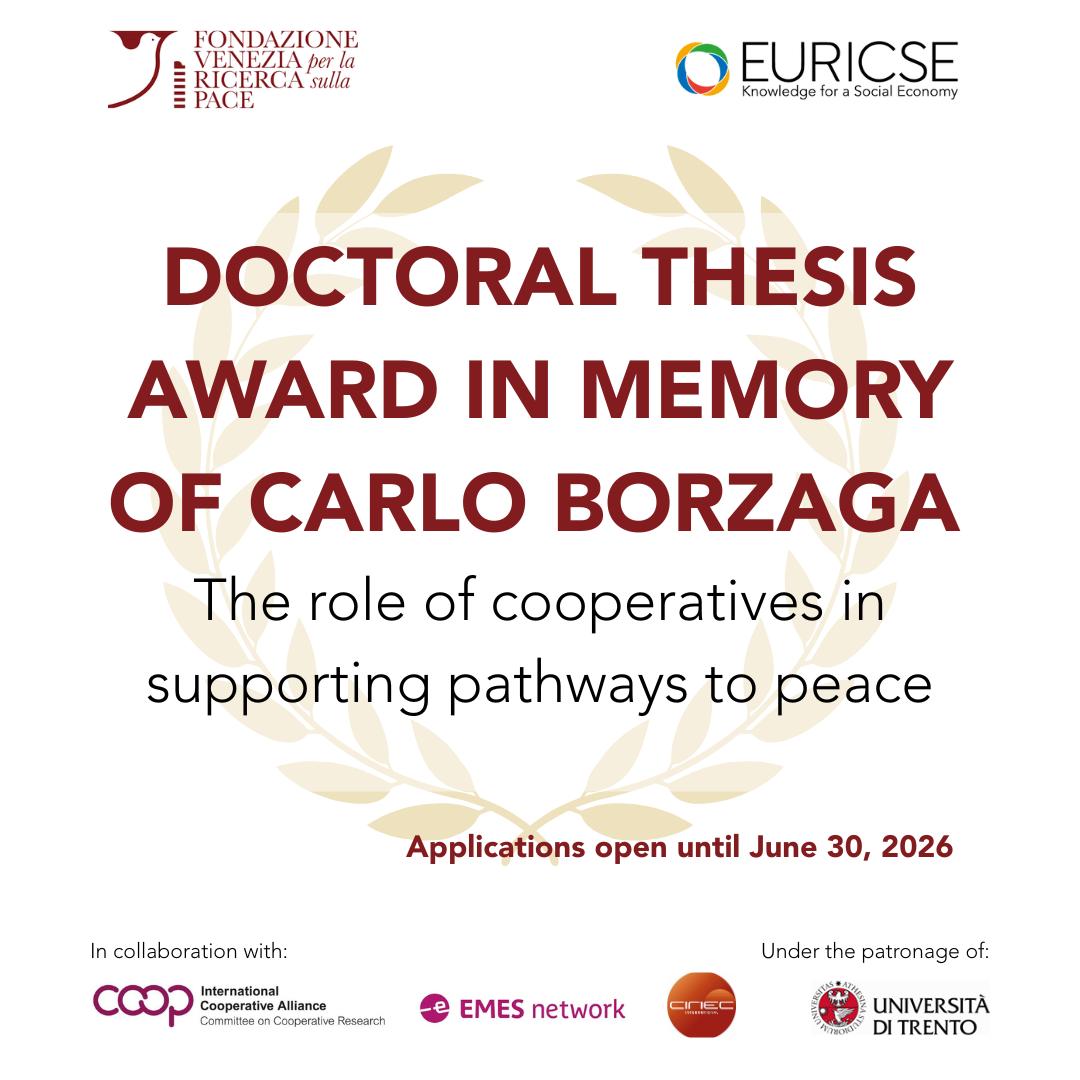
Doctoral Thesis Award in memory of Carlo Borzaga
Introduction
The Venice Foundation for Peace Research and EURICSE – European Research Institute on Cooperative and Social Enterprises announce the launch of a Doctoral Thesis Award in memory of Professor Carlo Borzaga. The Award, under the patronage of the University of Trento, is promoted in collaboration with the Committee on Cooperative Research of the International Cooperative Alliance (ICA CCR), the EMES International Research Network and CIRIEC International.
Funded by the Venice Foundation for Peace Research, the Award honours the memory of Professor Carlo Borzaga by rewarding research that explores the role of cooperatives in supporting pathways to peace.
Context
The United Nations General Assembly declared 2025 as the International Year of Cooperatives (IYC2025), under the theme “Cooperatives Build a Better World”. With this recognition, the United Nations highlights the role and contribution of cooperatives, and more broadly of social economy organizations, to building more just, sustainable, and peaceful societies based on democracy, participation, and solidarity.
Research shows that cooperatives can contribute concretely to collective well-being by promoting quality employment, accessible social services, sustainable housing, education, health, and environmental conservation. Through knowledge sharing and active citizen participation, cooperatives hold the power to foster inclusive economic growth, raise empathy and strengthen social cohesion within communities, by increasing trust and agency. Cooperatives are therefore not simply economic institutions that technically assign ownership and control rights to stakeholders other than investors; cooperatives can also be regarded as social institutions promoting peaceful coexistence among people, supporting economic democracy and leading to peace building as a condition for and goal of human development.
The Doctoral Thesis Award in memory of Professor Carlo Borzaga has been established within this framework to promote and acknowledge academic research that explores the contribution of cooperatives to building a fair, supportive, and sustainable future, wherein peace is both a means and an end to social progress.
Objectives of the Award
The Doctoral Thesis Award in memory of Professor Carlo Borzaga aims at promoting and acknowledging research that explores the role of cooperatives and social economy organisations in fostering more inclusive, democratic, and supportive societies.
This initiative supports research that highlights the contribution of cooperatives and more broadly social economy organisations to promoting peace, social justice, and sustainable development, understood as fundamental, interconnected values of civic coexistence among people sharing similar objectives.
The Award acknowledges and showcases studies that propose new theoretical and practical perspectives, in which cooperatives – including informal cooperative practices – are interpreted as a tool for collective well-being and for building a culture of and for peace.
Critical and interdisciplinary analyses proposing new ways of conceptualising cooperatives as vehicles for peace and conflict resolution will be particularly appreciated.
Eligibility Requirements
Researchers are eligible to participate in the competition if they meet the following requirements:
- They have obtained a doctoral degree from an Italian or foreign university;
- They doctoral thesis is written in English;
- Their research examines, using scientific methods, the role of cooperatives and social economy organisations in promoting peace, democracy, equality and solidarity;
- They defended their doctoral thesis between January 1st, 2023 and June 30th, 2026.
How to Apply
Interested candidates must submit their application by June 30th, 2026 at midnight CEST to the email address euricse@euricse.eu, attaching the following documentation in PDF format:
- Abstract in English (min. 3,000 – max. 5,000 words), accompanied by the thesis table of contents and complete bibliography;
- Full text of the doctoral thesis;
- Doctoral degree certificate, or – if not yet available – a declaration confirming successful completion of the doctoral defence (issued by the awarding institution, the supervisor or the candidate);
- Letter of motivation explaining how the thesis is consistent with the objectives of the Award. Candidates are strongly encouraged to specify how they intend to operationalise the findings of the doctoral thesis in real-world contexts;
- Supervisor’s (or co-supervisor’s) support letter;
- Curriculum vitae et studiorum of the candidate.
Failure to submit one or more of the required documents in full and by the stated deadline, may negatively affect the evaluation of the application or result in its exclusion.
* To review Euricse’s Privacy Policy, please refer to the dedicated section on the homepage of the Euricse website (at the bottom of the page).
Selection Process
The Award will be assigned through a selection process based on the evaluation of the scientific excellence of the thesis and the originality of its contribution to the analysis of the role of cooperatives in building pathways to peace.
A Selection Panel composed of scholars and experts in the humanities, social sciences, economics, law, and international studies, jointly appointed by the organisations promoting the Award, will evaluate applications. The Selection Panel will assess the submitted theses according to the following criteria:
- consistency with the objectives of the Award;
- methodological rigor and clarity of presentation;
- scientific relevance and social impact of the results achieved;
- innovativeness and originality of the research approach.
The Selection Panel may, at its sole discretion, request further information or clarification from applicants.
Award Amount and Scientific Publication
The total amount of the Award is EUR 2,500 (two thousand five hundred euros), gross.
The Selection Panel reserves the right not to assign the Award if none of the submitted theses are deemed worthy, or to award it to two candidates where warranted by merit. In such cases, the total amount will be shared between the selected theses, resulting in a proportional reduction of the individual award.
The organising committee will inform the winner(s) of the Award no earlier than the 1st of November 2026.
In addition to the monetary prize, the awardee(s) will be invited to publish an extract from their thesis in the Journal of Entrepreneurial and Organizational Diversity (JEOD), indexed in Scopus and published by EURICSE.
Carlo Borzaga (1948–2024)

Professor Carlo Borzaga, who passed away after a serious disease in March 2024, was one of the pioneers and most influential scholars in exploring cooperatives, the Third sector, and the social economy.
As a Professor of Economic Policy at the University of Trento (Italy) and author of numerous books, essays, and academic articles, he served from 1997 to 2008 as President of the Istituto Studi e Sviluppo Aziende Nonprofit (ISSAN), which later evolved into the European Research Institute on Cooperative and Social Enterprises (EURICSE). Professor Borzaga founded EURICSE in 2008 and chaired it until 2022. Today, the institute stands as an international reference point for research on the social economy.
Professor Borzaga was one of the founders of the EMES International Research Network and contributed to the founding of Iris Network, the Italian network of research institutes dealing with social enterprise, which he chaired for several years.
Professor Borzaga’s main research interests include the labour market, cooperative and social enterprises and the evolution of these organizational forms at European and international level, the transformation of welfare systems, and the organization of social and health services. He has participated as a scientific supervisor in numerous international research projects and has widely consulted for local authorities, the Italian government and international organisations including the OECD, the ILO and the European Commission.
Alongside his scientific work, Professor Carlo Borzaga has been an active cooperator, contributing to the founding and/or management of several social cooperatives and consortia at local and national level.
His experience, gained through research and practice, contributed to the drafting of the first laws on social cooperatives in Trentino and Italy. He participated in the drafting of Trentino Provincial Law No. 35/1983 tackling social exclusion, Trentino-Alto Adige Regional Law No. 24/1988 on social solidarity cooperatives, and contributed to drafting Italian Law No. 68/1999 regulating the integration of people with disabilities into the labour market, as well as other regulations on social enterprise and local welfare.
A firm supporter of education and youth engagement, Professor Borzaga promoted numerous educational initiatives. Among these, he contributed to the founding of the Master’s Degree in Management of Social Enterprises (Master GIS), jointly promoted by EURICSE and the University of Trento. This is the longest-running postgraduate programme in Italy for training managers in the non-profit sector and social enterprises, and has now reached its 30th edition.
Award Promoters
- Venice Foundation for Peace Research
The Venice Foundation for Peace Research (Fondazione Ve.Ri.Pa) brings together key public institutions and leading cultural and academic organizations committed to advancing research, dialogue, and collaboration on issues of peace, security, and sustainable development. The Foundation conducts interdisciplinary research, collaborates with national and international institutions, and promotes the public dissemination of scientific results. Fondazione Ve.Ri.Pa serves as a regional and international center dedicated to fostering academic research, public awareness-raising and collaborative initiatives aimed at strengthening widespread institutional and civic engagement in the name of a culture of peace and intercultural understanding.
- EURICSE
The European Research Institute on Cooperative and Social Enterprises (EURICSE) is a research institute based in Trento (Italy). EURICSE’s mission is to promote knowledge development and innovation for the field of cooperatives, social enterprises and other non-profit organizations engaged in the production of goods and services. EURICSE aims to deepen the understanding of these types of organizations and their impact on economic and social development, furthering their growth and assisting them to work more effectively. In addition to research, EURICSE designs and organizes training programs specifically aimed at the professional development of young researchers and at enhancing the skills and knowledge of those who work in non-profit enterprises and organisations, with particular attention to innovation processes.
- University of Trento
The University of Trento (UniTrento) is an academic community that combines quality, innovation and openness to the world. Located in the heart of the Alps, surrounded by nature and culture, the University is recognised nationally and internationally for its excellent teaching, research and services. The University of Trento offers a dynamic and inclusive environment, in which students, professors and researchers work together to create and disseminate knowledge. The relational dimension and the quality of study programmes are central for the academic experience, and are backed by services that promote student well-being and engagement. The University collaborates with over 400 universities in Europe and around the world through mobility programmes, double degrees, summer and winter schools and joint academic programmes. A multicultural community enriches university life and contributes to the development of transversal skills, which are useful to work in complex global contexts.
- Committee on Cooperative Research of the International Cooperative Alliance
The Committee on Cooperative Research (CCR ICA) is a thematic committee of the International Cooperative Alliance. It is a bridge between academic research and the cooperative world. The CCR aims to strengthen research activities and increase the visibility of cooperative research and researchers. One of the main activities of the CCR is the organisation of research conferences at the global and regional levels, including the biennial Global Research Conference. The papers of the international conference are published in special issues of the Review of International Cooperation and via other research information sources. The committee also makes an effort to promote cooperative research through various communications vehicles.
- EMES International Research Network
EMES is a research network comprising 14 established university research centres and over 300 individual researchers from more than 50 countries. Together, they aim to gradually build an international corpus of multidisciplinary theoretical and empirical knowledge, as well as methodologies, around key “SE” concepts: social enterprise, cooperatives, social entrepreneurship, social economy, solidarity economy, and social innovation. EMES has conducted more than 15 international comparative research projects and has held ten major international conferences and doctoral training schools since 2001. Founded in 1996, EMES later opened its membership to established scholars, early-career researchers, and PhD candidates worldwide. Members self-organise into dynamic Affinity Groups and the EMES PhD Network, which organises webinars and meetings, training activities, and a mentoring programme. Additionally, EMES collaborates with international organisations and governments at all levels to advance understanding of the SE field and to support evidence-based policymaking globally
- CIRIEC International
The International Centre of Research and Information on the Public, Social and Cooperative Economy (CIRIEC) is a non-governmental international scientific organisation created in 1947. Its objectives are to undertake and promote the collection of information, scientific research, and the publication of works on economic sectors and activities oriented towards the service of the general and collective interest. These include actions by national, regional, and local public authorities in economic fields; public utilities; public and mixed enterprises; and the social economy sector. In these fields, CIRIEC develops activities of interest for both managers and researchers, offering opportunities for mutual enrichment.
Download the Call for Proposals